
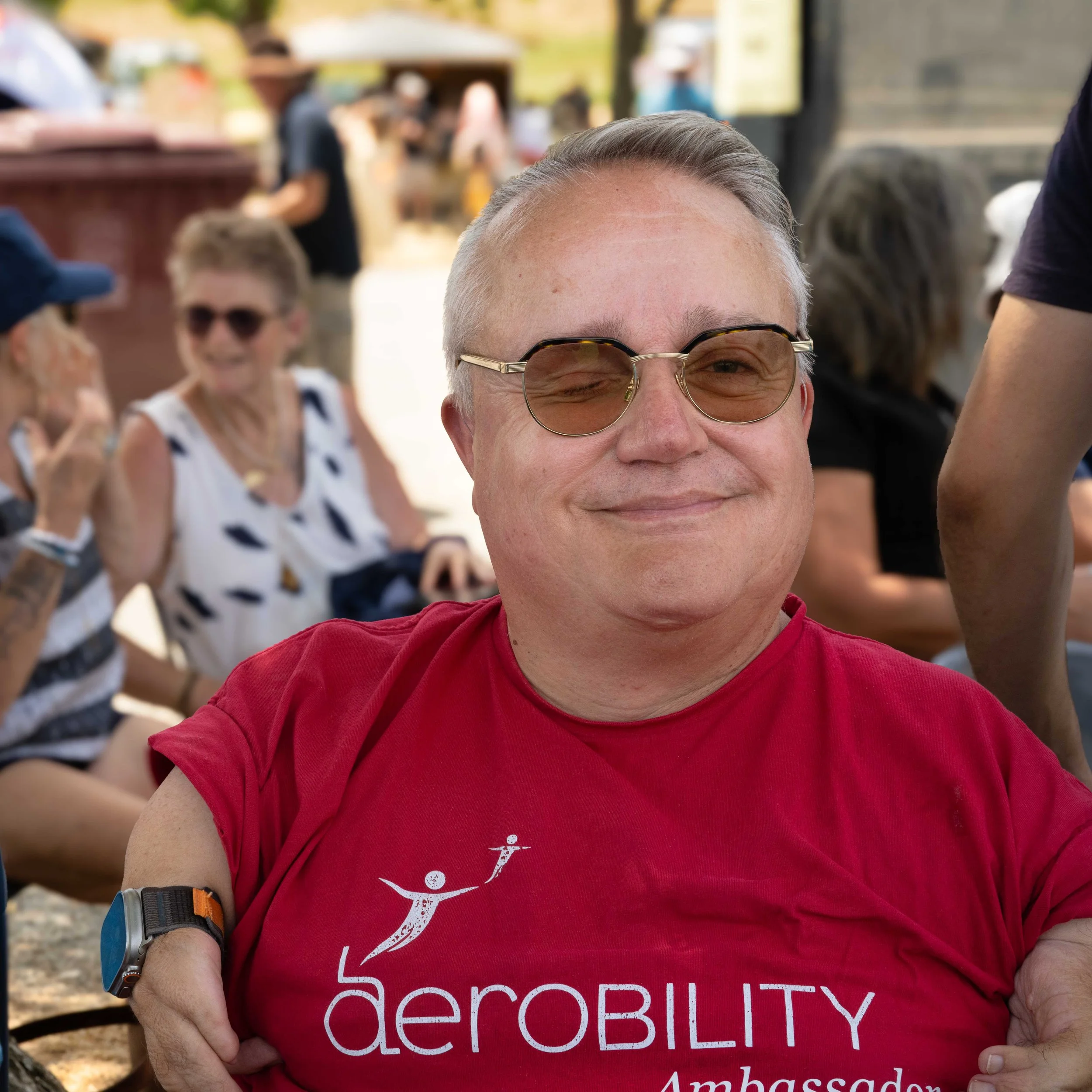
A headshot of Geoff Spink wearing his Aerobility Ambassador T-Shirt
How does a fashion-conscious young woman, aged 20, make herself half an inch taller? The brief answer is, she doesn't, but that was how my mum tried and failed to join the Air Transport Auxiliary during World War II. Fashion-conscious because she was absolutely sure she didn't want to join the army and have to wear the khaki uniform, which she didn't think much of. The WAAF (Women's Auxiliary Air Force) uniforms were apparently a more acceptable colour and looked so much smarter.
Once she was 'a WAAF', and had had a couple of flights with friendly airmen, she decided that she just had to have a go at flying herself - hence her application to join the ATA. Although excluded from combat flying, ATA pilots played a vital role in delivering new aircraft and moving them from one airfield to another.
The slight snag was that, to be considered, women had to be 5'4" (163cm). My mum was a measly 5'3.5" (161cm). Half an inch - there's nothing in it, is there? So she thought, "I'll put some cotton wool in my stockings and just 'borrow' that extra half inch." The cotton wool went flat as a pancake under her body weight, and she was still under 5'4". What she did pass on to me was an abiding passion for aviation, plus, while on active duty in the Middle East, she met my dad, Harry, an RAF sergeant.
When it comes to my own aeronautical aspirations, there was a little bit more than half an inch of height standing twixt me and the cockpit: I was born with severely impaired vision and extremely short arms as a result of the drug, thalidomide. Was I ever going to be able to fly an aeroplane? Forget it! What about driving a car (my other great longing)? None of that either.
Fast forward 40-odd years, and I'm working at the BBC and covering the Mobility Roadshow, which was held at Kemble Airfield. The press lady was very keen for me to meet an organisation called Aerobility, "They may even take you up for a flight," she urged. They did take me up, but it took much longer for the penny to drop. I told myself that this was an organisation for disabled veterans or people who had had a spinal injury, not people like me who were born with an eye missing and shortened limbs.
After leaving the BBC, I ran my own disability consultancy, and I continued to follow Aerobility on social media. That's how, in 2022, I came across something called the Virtual Aviation Experience, or VAE. A Twitter post announced three free sessions for disabled people to have instruction by a qualified pilot using an online simulation tool called GeoFS. You could do it from the comfort of your own home, they supplied the joystick. "Well", I thought to myself, "even I can't cause any damage in a virtual aircraft."
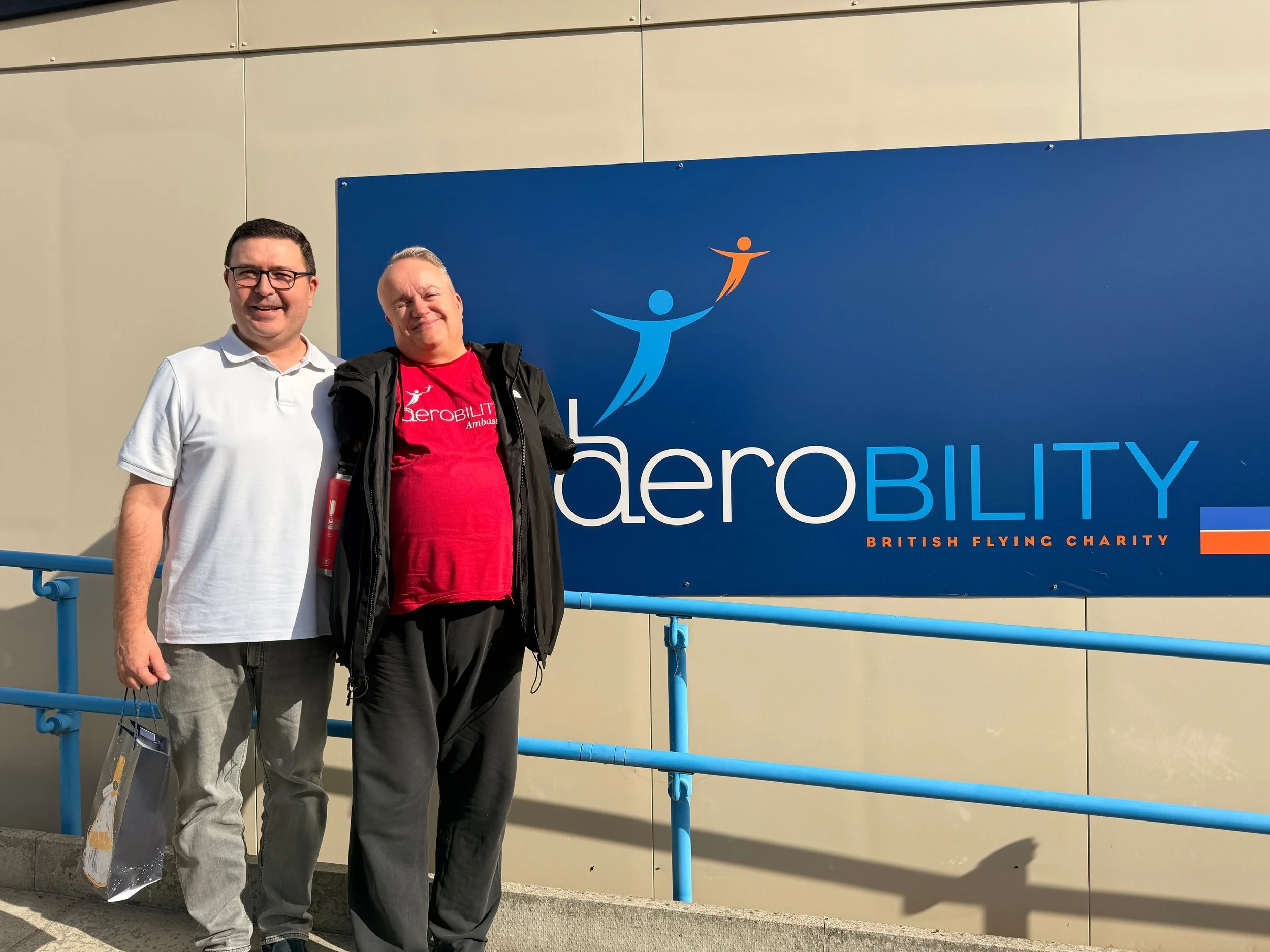
Mark Rothwell (left) and Geoff Spink (right) pose for a picture against an Aerobility sign.
I applied and thoroughly enjoyed my sessions with my instructor, Mark Rothwell. At the end of our time together, he asked me a very simple question: Why wasn't I flying in the real world, given my obvious passion for aviation? "Because", I said, "I'm registered blind." "So what?" he said. I applied for a scholarship, at his suggestion, and spent five hours in the air with Aerobility's then Chief Flying Instructor, Mike Owen. Now, there was no stopping me — well, if you consider the acquisition of a PPL an obstacle, there was that — but I was, and I am still, able to fly under the supervision of an instructor, which is an awful lot better than not flying at all.
If Aerobility was a stick of seaside rock, it would have "can do" written all the way through it. This is an organisation that encourages people to do what they can and to enjoy it rather than finding reasons why they can't. Though I will never get my private pilot's licence, I do consider myself a student pilot — I'm taking my ground exams so that I have the theoretical knowledge to back up what I learn in the cockpit.
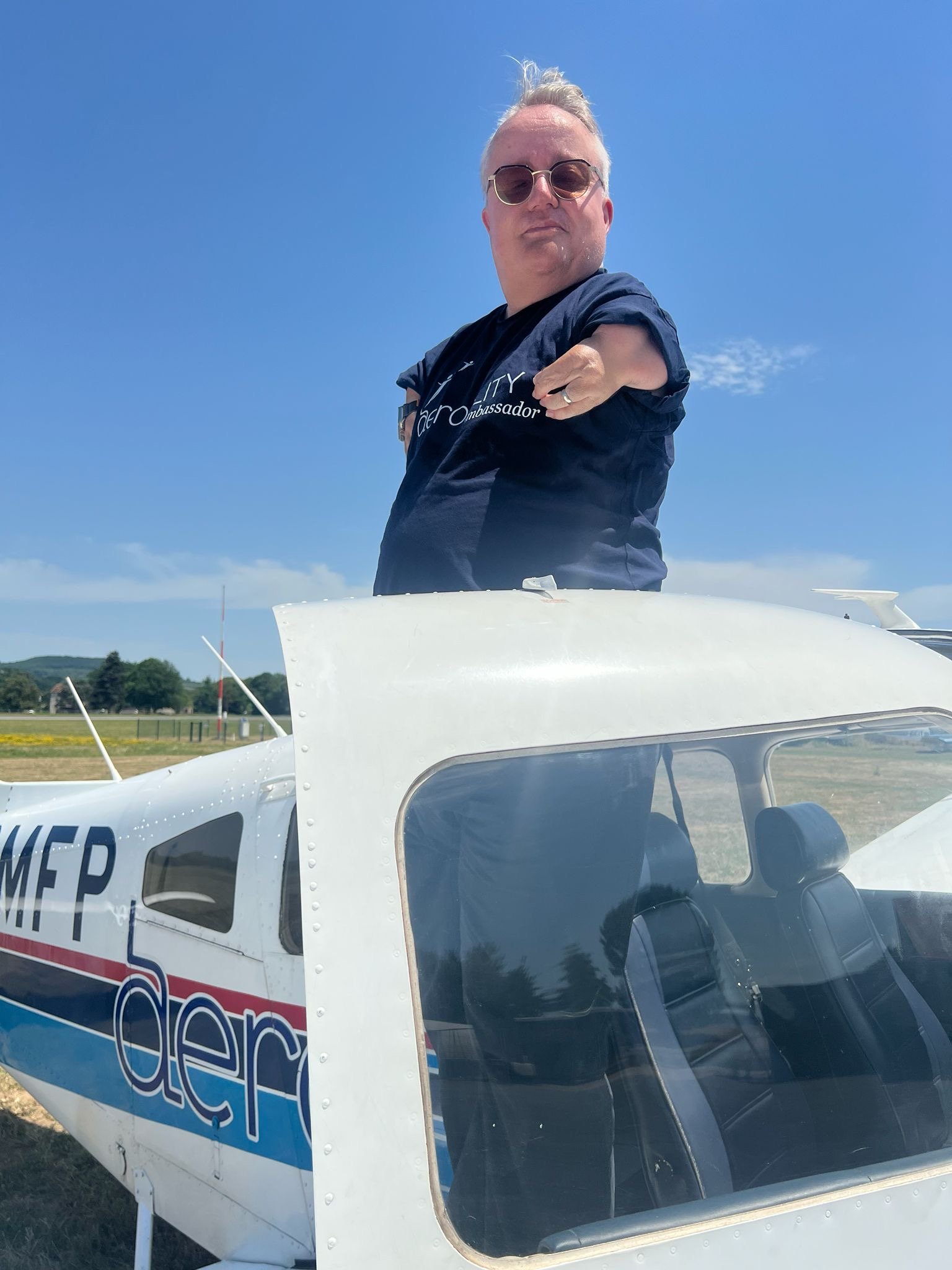
Geoff stands on the wing on an Aerobility aeroplane
Pretty soon, I became an ambassador for Aerobility, representing the charity at public events and banging the drum, or rattling the bucket, so that we can fund more of that incredible activity called flying. When Aerobility advertised for new trustees, I didn't have to think twice: I already had considerable experience as a trustee on the boards of other charities; it wasn't just my passion for flying that I was bringing to the boardroom.
I can't wait to roll up my sleeves and get cracking: Aerobility has given me so much, and I will bring my energy, enthusiasm and persistence to bear in helping the charity to achieve its goal of making aviation accessible to all, regardless of ability or impairment.